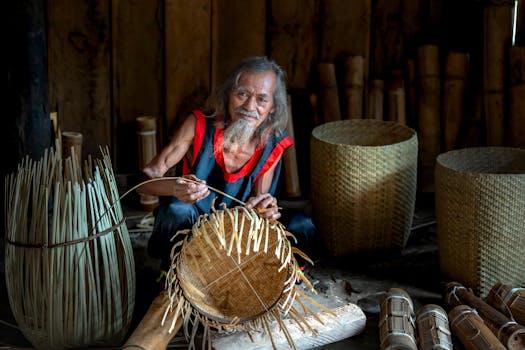
The Language of Weaving: How to Perceive and Interpret Symbols in Traditional Baskets
Across continents and centuries, traditional baskets have served as more than just practical containers. These woven creations are rich with meaning, their patterns and motifs communicating stories, beliefs, and social messages that often transcend words. Learning how to perceive and interpret the symbols woven into traditional baskets is both an art and a science—a journey into the heart of a culture’s visual language.
In this article, we’ll dig deep into the methods for recognizing, analyzing, and understanding symbols in traditional basketry. We’ll explore how context, technique, and even the very materials used contribute to meaning, and we’ll offer practical strategies for decoding the visual stories told by baskets from around the world.
The Roots of Symbolism in Basketry: A Global Perspective
Symbolism in basketry is as old as the craft itself. From the Zulu people of South Africa to the Hopi of the American Southwest, weavers have long used specific designs to encode messages and express identity. In fact, archaeological evidence shows that basketry dates back over 10,000 years, with ancient examples found in Egypt, Peru, and the Middle East.
Why did symbols become so important in baskets? For many cultures, baskets were not only utilitarian objects but also ceremonial, trade, and status items. For example, a 2017 study found that 80% of traditional Native American baskets collected in California featured at least one symbolic motif. In Papua New Guinea, certain basket designs are reserved for specific ceremonies or social ranks.
Understanding symbolism requires recognizing that each culture develops its own visual vocabulary. The same spiral motif, for example, might represent water in one culture and spiritual journey in another. Thus, interpretation starts with context.
Recognizing Common Symbolic Motifs in Traditional Baskets
The first step in interpreting basket symbols is pattern recognition. Some motifs recur across continents, while others are unique to specific peoples. Here are a few of the most common symbolic motifs found in traditional baskets:
- $1 Often associated with cycles, eternity, or the sun. For the Hopi, a spiral can symbolize migration. - $1 Frequently interpreted as water or serpents in Native American and African traditions. - $1 May represent fertility, the womb, or the four directions. - $1 Common in Southwest American baskets, often signifying rain, mountains, or spiritual ascent. - $1 Specific animals (e.g., turtles, fish, birds) or plants (e.g., maize, reeds) can symbolize clan lineage, abundance, or environmental features. - $1 Colors themselves can be symbolic. For example, in Navajo baskets, black may represent darkness or the underworld, red the earth, and white the sky.It is important to note that even within a single culture, the meaning of a symbol may vary depending on the basket’s purpose, the region, or the weaver’s intent.
Context is Key: Decoding Meaning Through Cultural and Practical Clues
Interpreting basket symbols requires more than identifying shapes and motifs. Context—historical, cultural, and functional—is crucial in unlocking deeper meaning.
- $1 Learning about the community that made the basket is essential. For example, the Wounaan of Panama are renowned for their tightly woven baskets adorned with intricate geometric and animal designs, each reflecting spiritual beliefs and environmental observations. - $1 Was the basket made for daily use, trade, religious ceremony, or as a gift? Ceremonial baskets often feature more elaborate symbolism. - $1 Some cultures reserve certain fibers or dyes for special occasions. For instance, the use of rare red ochre dye in Australian Aboriginal baskets signifies spiritual potency. - $1 In smaller communities, individual weavers might incorporate personal or family symbols, making each basket a unique narrative artifact.A practical example: A 19th-century Pomo basket from California featuring a recurring quail feather motif may symbolize abundance and prosperity, especially if the basket was intended as a wedding gift.
Comparing Symbolic Traditions: A Cross-Cultural Table
To better understand how symbols function across cultures, the following table provides a comparative overview of symbolic motifs found in traditional baskets from various regions:
| Culture/Region | Common Motifs | Typical Symbolic Meanings | Materials/Colors Used |
|---|---|---|---|
| Hopi (USA) | Spirals, step patterns, kiva symbols | Migration, rain, spiritual journey | Yucca, willow; natural dyes |
| Zulu (South Africa) | Triangle, chevron, diamond | Family, gender, social status | Ilala palm; earth tones, black/white |
| Wounaan (Panama) | Geometric, animal motifs | Nature spirits, ancestors | Chunga palm; vibrant colors |
| Ainu (Japan) | Geometric swirls, plant forms | Protection, harmony with nature | Bamboo, bark; subdued tones |
| Aboriginal (Australia) | Concentric circles, lines | Waterholes, travel routes | Pandanus, red ochre, yellow clay |
This comparison shows how diverse yet interconnected basket symbolism can be. While motifs are often visually similar, their meanings are deeply rooted in local context.
Techniques for Perceiving and Analyzing Basket Symbols
If you’re looking to become more skilled at interpreting basket symbols, try the following step-by-step approach:
1. $1 Carefully examine the basket’s surface. Note the motifs, color combinations, and overall composition. Take photographs or sketches if possible. 2. $1 Write down any recurring shapes, patterns, or animals. Are there symmetrical or repeating elements? 3. $1 Where and when was the basket made? If possible, identify the weaver or community. 4. $1 Use books, museum catalogs, or academic articles to identify known motifs and their interpretations. The Smithsonian Institution, for example, has an online database of over 2,000 cataloged basket designs. 5. $1 If you’re studying baskets from a living tradition, try to connect with community members, weavers, or anthropologists who can offer firsthand explanations. 6. $1 Consider the basket’s size, shape, and intended function. A small, tightly woven “gift” basket may carry different symbolism than a large harvesting basket. 7. $1 Remember that symbols can be layered with meaning—and that your own cultural lens may influence your perception.Developing this analytical habit can lead to richer insights and a greater appreciation for the complexity of traditional basketry.
Case Studies: Reading the Stories Woven into Baskets
Let’s apply these techniques to a few concrete examples:
- $1 These baskets often feature rare quail feathers and clamshell beads. The inclusion of feathers is more than decorative—it represents the Pomo’s connection to nature and the spiritual world. The use of redbud and sedge root, both hard to work with, signals the basket’s ceremonial importance. - $1 Known as “ukhombe,” these baskets are adorned with geometric patterns. A triangle pointing upward can symbolize masculinity, while the same shape pointing downward represents femininity. The arrangement of these motifs tells a story about social roles and family lineage. - $1 Featuring vibrant animal motifs, these baskets often depict the jaguar, revered as a protector spirit. The complexity of the design and the use of rare dyes can signal the basket’s role in important life events, such as marriages or initiations.These case studies highlight how symbols, materials, and context come together to create a layered narrative, one that can be read by those who know the code.
Final Reflections on Interpreting Symbols in Traditional Baskets
Woven baskets are more than products of skill—they are visual texts, carrying generations of meaning. To perceive and interpret the symbols in traditional baskets is to unlock a unique form of storytelling, one that bridges the practical and the sacred, the individual and the communal.
By combining careful observation, research, and cultural sensitivity, anyone can begin to appreciate the language of basketry. As with any art form, the process of interpretation is ongoing, and each basket invites us to look closer, ask questions, and deepen our understanding of the worlds they represent.