Navajo Baskets: How They Differ from Other Traditional Designs
For centuries, basketry has been a vital art form for indigenous peoples throughout North America. Each culture brings its own history, symbolism, and technique to their basket weaving traditions, producing objects that are both functional and deeply meaningful. Among these, Navajo baskets stand out for their distinctive aesthetics, ceremonial roles, and unique weaving methods. But how exactly do Navajo baskets differ from other traditional designs, such as those made by neighboring tribes like the Hopi, Apache, or Pima? In this article, we’ll explore the history, symbolic language, construction techniques, and cultural roles that set Navajo baskets apart, illuminating the artistry and significance behind every piece.
The Historical Roots of Navajo Basketry
Basketry predates pottery in the Southwest, with archaeological evidence indicating its presence in the region over 8,000 years ago. The Navajo, or Diné people, are believed to have adopted basket weaving around the 17th century, influenced by neighboring Puebloan and Ute tribes. However, by the late 1800s, Navajo weavers developed their own distinctive style, departing from purely utilitarian forms to create baskets that were rich in symbolic meaning and ceremonial use.
Unlike other tribes that often used baskets for daily storage or food preparation, the Navajo baskets’ primary purpose became ceremonial. The most famous type, the Navajo ceremonial basket, or "ts’aa’," is integral to rituals like the Kinaaldá (girl’s puberty ceremony) and other healing rites. This ceremonial focus is a major distinguishing factor from the often utilitarian or decorative baskets of other Native American traditions.
Design Elements: Patterns and Symbolism
One of the most striking differences between Navajo baskets and those of other tribes lies in their design motifs and symbolism. Navajo baskets are renowned for their bold, geometric patterns, often rendered in black, red, and natural white. The classic design features a central black or red circle, radiating zigzags, and a black rim, each with deep symbolic significance.
For example, the center typically represents the emergence place—the Navajo origin story’s beginning. The radiating lines symbolize the four sacred mountains, the cardinal directions, or the journey of life, while the black rim is believed to offer protection. Perhaps most uniquely, every Navajo ceremonial basket includes a “spirit pathway”—a deliberate break in the pattern along the rim, said to allow the spirit of the basket (or the ceremony’s participants) to move freely in and out. This is a feature not commonly found in other tribal basketry.
In contrast, Hopi baskets often employ more pictorial designs, depicting animals, rain clouds, or kachina figures. Apache baskets frequently feature human forms, animals, or elaborate star patterns, while Pima baskets are known for their intricate, tight weaves and stepped geometric motifs. The consistent use of the spirit pathway and the strict adherence to certain symbolic elements are hallmarks of Navajo design.
Materials and Weaving Techniques
The choice of materials and weaving methods further set Navajo baskets apart. Traditionally, Navajo basket weavers use willow shoots, sumac, or yucca, gathered from local environments with great care and respect. These materials are split and soaked to achieve the flexibility needed for coiling.
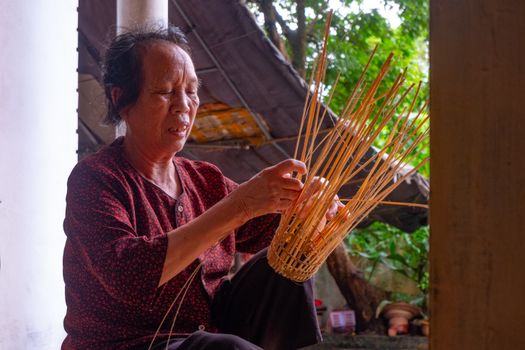
The primary construction method for Navajo baskets is the single-rod coiling technique. This involves wrapping a bundle of willow or sumac with a thin, flexible splint, then stitching each coil to the next with the same material. The process is painstaking: a medium-sized ceremonial basket can require 40 to 60 hours to complete.
By comparison, Hopi and Apache weavers often use a similar coiling technique but with different plant fibers and tighter, more intricate stitches. The Pima, Papago (Tohono O’odham), and Yavapai tribes frequently use a two-rod or three-rod coiling, enabling more complex geometric designs and tighter weaves. Furthermore, some tribes, like the Cherokee or Chitimacha, employ plaiting or twining techniques rather than coiling, yielding baskets with entirely different textures and structural properties.
Comparing Basketry Traditions: A Closer Look
To better understand the distinctions among Navajo baskets and those of neighboring tribes, it helps to compare their core characteristics side by side. The table below summarizes some key differences in design, function, and technique.
| Tribe | Typical Use | Main Materials | Weaving Technique | Common Motifs | Unique Feature |
|---|---|---|---|---|---|
| Navajo | Ceremonial | Willow, sumac, yucca | Single-rod coiling | Geometric (zigzags, radiating lines) | Spirit pathway in rim |
| Hopi | Ceremonial, utilitarian | Rabbitbrush, sumac, yucca | Coiling, plaiting | Pictorial (kachinas, animals) | Use of color dyes |
| Apache | Utilitarian, ceremonial | Willow, devil’s claw, yucca | Single-rod coiling | Human/animal forms, stars | Burden basket with leather straps |
| Pima | Utilitarian | Willow, cattail, devil’s claw | Two/three-rod coiling | Geometric, stepped patterns | Extremely tight weave |
Cultural and Ceremonial Roles
Perhaps the most profound difference lies in how baskets are used within each culture. For the Navajo, baskets are not merely containers; they are sacred objects, imbued with spiritual significance. The ceremonial basket plays a central role in rites of passage, healing ceremonies, and prayers. For instance, during the Kinaaldá, a ceremonial basket is used to hold ceremonial cornmeal and is carefully passed around as part of the ritual.
The importance of the spirit pathway—always left open in the rim—underscores the belief that baskets are living entities, channels for prayers and blessings. Breaking the rim’s pattern is considered essential for maintaining spiritual balance, a practice that is distinctive to Navajo basketry.
In other cultures, baskets can also have ceremonial uses but are more commonly employed for daily life: storing seeds, carrying food, or transporting goods. Hopi baskets are used in the Snake Dance and other rituals but often feature more narrative imagery. Apache burden baskets, equipped with leather straps, are iconic utilitarian tools traditionally carried by women for harvesting and gathering.
Modern Revival and Artistic Innovation
While the arrival of manufactured goods in the 20th century led to a decline in basketry across many indigenous cultures, the unique role of the ceremonial basket has ensured its survival among the Navajo. In recent decades, a new generation of Navajo weavers—both men and women—have revitalized the art, blending tradition with innovation. Contemporary Navajo baskets may experiment with color, scale, and abstracted patterns, but still honor the core elements: the radiating design, the spirit pathway, and the use of natural materials.
This revival is not just artistic but economic as well. According to the Indian Arts and Crafts Board, the Native American basketry market in the United States was valued at over $15 million in 2023, with Navajo ceremonial baskets accounting for a significant portion of high-end sales. Museums and collectors worldwide now seek Navajo baskets for their beauty and cultural significance.
Why Navajo Baskets Remain Distinctive Today
Navajo baskets are more than works of art—they are vessels of cultural memory and spiritual connection. What sets them apart from other traditional designs is not just their appearance, but the philosophy behind their creation. The emphasis on ceremonial use, the consistent incorporation of symbolic motifs, and the presence of the spirit pathway all contribute to a tradition that is uniquely Navajo.
Their continued production and evolution attest to the resilience and creativity of Navajo artists, who honor their ancestors while expressing new visions in every coil and stitch. For collectors, historians, and anyone interested in indigenous arts, understanding these differences enriches the appreciation of basketry and the cultures that sustain it.